Theory U: The Value of Slowing Down to Move Forward
Much of my work, whether through coaching, mentoring, supervision or facilitation, is grounded in creating space for others to think, explore and find their own way forward. Rather than assuming that I need to have the answer, I am interested in what becomes possible when we remain curious, pay attention to what is happening within and around us, and resist reaching conclusions before exploring what might be there.
Developed by Otto Scharmer, Theory U alligns with my practice as it offers an approach to leadership and systems change that brings together systems thinking, awareness, listening and action. It invites us to consider not only what we pay attention to, but how we pay attention, recognising that our previous experiences and assumptions can influence what we notice and the possibilities we consider (Scharmer, 2016).
Understanding the Stages of Theory U
The U represents a journey from deeper observation and awareness towards emerging possibilities and action.
The process is commonly illustrated through six stages (Scharmer, 2016, 2018):
- Co-initiating – Building common intent: Developing shared purpose, listening to what matters and creating the conditions for meaningful engagement.
- Co-sensing – Observing and listening: Exploring different perspectives, questioning assumptions and becoming more aware of the relationships and wider systems influencing a situation.
- Presencing – Connecting with what is emerging: Creating space for reflection and deeper awareness, allowing new possibilities to become visible without immediately seeking solutions.
- Crystallising – Clarifying emerging possibilities: Developing greater clarity around emerging ideas and identifying intentions or directions that might be worth exploring.
- Prototyping – Learning through action: Experimenting with ideas, gathering feedback and adapting through experience rather than waiting for a fully developed solution.
- Co-evolving – Embedding and developing what emerges: Working collaboratively to develop and sustain new approaches, recognising that change and learning continue within the wider system.
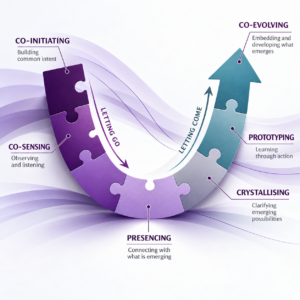
Two important concepts underpin this journey: letting go and letting come.
Letting go involves loosening our attachment to familiar interpretations and assumptions, while letting come invites openness to perspectives and possibilities that may not have been apparent initially. Neither requires us to abandon our knowledge or experience, but rather to recognise when these might be limiting what we can see.
What Might This Offer Leaders?
Leadership often involves complexity, uncertainty and competing perspectives; previous experience may be valuable, but may also narrow how situations explored and are understood. Theory U encourages leaders to widen their perspective, listen more deeply and consider what might emerge when they resist moving too quickly towards familiar solutions.
This might involve reflecting on questions such as:
- Whose perspectives have I not yet heard?
- What assumptions might be influencing my understanding?
- What am I noticing within the wider system?
- What might become possible if I temporarily let go of my preferred solution?
Creating space for exploration does not mean avoiding decisions. It can enable leaders to make more informed choices, involve others meaningfully and experiment with approaches that develop through feedback and shared learning.
What About Coaches, Mentors and Supervisors?
There are equally valuable connections with coaching, mentoring and supervision, where professional knowledge and experience inevitably influence how we listen and interpret what we hear. We may recognise familiar patterns, draw comparisons with previous clients or begin developing hypotheses, while cognitive biases such as confirmation bias, anchoring bias and affinity bias may also influence our interpretations. Remaining aware of these potential influences is particularly important when we recognise that every person brings their own experiences, perspectives and circumstances, shaped by the relationships and wider systems of which they are part.ystems.
Theory U offers a useful reminder to hold those thoughts lightly, remaining curious about the person in front of us while also paying attention to the relationships, environments and wider systems influencing their experiences.
This does not necessarily require practitioners to adopt another model or follow a prescribed process. Instead, Theory U provides an additional perspective on presence, curiosity and the value of creating space for others to develop their own awareness, understanding and possibilities for action.
Creating Space for What Might Emerge
“The ability to shift from reacting against the past to leaning into and presencing an emerging future is probably the single most important leadership capacity today.” Otto Scharmer (Scharmer & Kaufer, 2013)
Theory U invites us to consider how our assumptions, experiences and habitual responses shape the way we engage with others and the situations we encounter. Slowing down does not necessarily mean delaying progress; sometimes, creating space for deeper listening, reflection and exploration is precisely what enables us to move forward with greater awareness and intention.
TIME TO REFLECT: Where might holding what you think you already know a little more lightly create space for a different possibility to emerge?
Explore Further: Coaching Across Cultures
Our ICF approved 10 CCE course Coaching Across Cultures, available through the Jigsaw Learning Hub, explores how our cultural values, beliefs, assumptions and unconscious biases can influence the way we understand, communicate and connect with others.
Building on some of the ideas explored in Theory U, the course invites practitioners to reflect on their own cultural perspectives, recognise potential biases and consider how these might influence their coaching relationships and professional practice.
Why not explore this self-paced, self-study professional development opportunity on the Jigsaw Learning Hub?
References
Scharmer, O. C. (2016). Theory U: Leading from the future as it emerges (2nd ed.). Berrett-Koehler Publishers.
Scharmer, O. C. (2018). The essentials of Theory U: Core principles and applications. Berrett-Koehler Publishers.
Scharmer, O. C., & Kaufer, K. (2013). Leading from the emerging future: From ego-system to eco-system economies. Berrett-Koehler Publishers.