Incremental Change: Why Lasting Growth Happens One Piece at a Time
There’s something incredibly tempting about dramatic transformation. The bold announcement, the complete reinvention, the promise that everything will suddenly change overnight.
But, in reality, meaningful and sustainable growth rarely happens that way.
Whether we’re talking about leadership, coaching, organisational culture, personal habits, or professional development, the most lasting change is usually incremental. Quiet. Consistent. Intentional.
One conversation, one new awareness, one small behavioural shift repeated over time.
When enough of those small pieces come together, something significant begins to emerge.
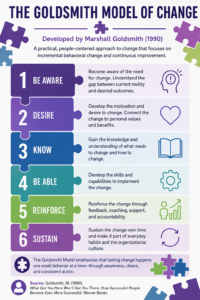
This is one of the reasons I’ve always appreciated the work of Marshall Goldsmith and his focus on behavioural change.
Goldsmith’s work highlights a simple but powerful reality: sustainable change is not usually about becoming a completely different person overnight.
It is about making measurable, practical adjustments to behaviour consistently over time.
At Jigsaw.coach, this idea connects deeply with how we approach coaching, supervision, training delivery and leadership development. Because real growth is rarely linear, and it is almost never instant.
The Problem With “Big Change”
Many people approach development with an all-or-nothing mindset. Leaders decide they need to completely change their communication style, organisations launch enormous culture initiatives all at once, or individuals attempt to overhaul every habit simultaneously.
The difficulty with the ‘big’ is that radical change often overwhelms the nervous system, disrupts consistency, and creates pressure that is difficult to sustain.
Incremental change, on the other hand, is more psychologically manageable.
Small behavioural shifts create evidence of progress —> progress builds confidence —> confidence increases motivation —> motivation supports further action.
This cycle matters!
Research across behavioural science and change theories consistently highlights the importance of awareness, motivation, intentional action, reinforcement, and long-term maintenance in supporting sustainable behavioural change (Kwasnicka et al., 2016; Prochaska & DiClemente, 1983; Ryan & Deci, 2017).
In other words: lasting change is built through repetition, reflection, and reinforcement – not through pressure alone.
What This Looks Like in Leadership
In leadership development, incremental change is often underestimated because it can appear too simple, but small changes in behaviour can completely alter the experience people have of a leader.
For example:
- A leader pauses before responding instead of reacting immediately.
- A manager replaces assumptions with one genuinely curious question.
- Feedback becomes more invitational and less directive.
- Meetings begin with listening rather than telling.
- Leaders become slightly more aware of their own bias, patterns, or emotional responses.
Individually, these may seem like minor adjustments but collectively, they can transform trust, psychological safety, accountability, engagement, and team culture over time. They are small pieces that gradually reshape how leaders think, communicate, and show up.
Incremental Change Requires Awareness
None of this can happen without awareness because we cannot intentionally change what we cannot yet see. Awareness is often the first and most important step in behavioural change. This is where coaching, supervision, reflective practice, and high-quality feedback become so valuable.
They help us notice:
- habitual responses
- assumptions
- blind spots
- emotional triggers
- patterns of communication
- unhelpful defaults
- systemic influences around us.
But awareness only becomes meaningful when translated into intentional action. Bear in mind that action does not have to be enormous, it simply needs to be consistent.
The Jigsaw Perspective
This is one of the reasons the company ‘jigsaw’ metaphor has always resonated so strongly.
Growth is rarely about finding one magical missing piece. It is about gradually assembling many smaller pieces: awareness, reflection, experimentation, feedback, courage, accountability, practice, and learning.
Some pieces arrive quickly, others take time, and some only make sense when viewed alongside the wider picture. Often, what initially feels like a very small shift becomes the piece that changes everything else around it.
Final Reflections
Don’t underestimate the power of small behavioural changes simply because they do not feel dramatic in the moment.
Remember that sustainable growth is rarely built through intensity alone. It is built through consistency: one conversation, one interaction, one insight and one intentional shift at a time. Over time, those small pieces begin to create a very different picture altogether.
References
Goldsmith, M. (2003). Coaching for behavioural change. Business Strategy Review, 14(3), 8–17.
Goldsmith, M. (2007). What got you here won’t get you there: How successful people become even more successful. Hyperion.
Goldsmith, M. (2025). Coaching for behavioral change. Marshall Goldsmith. Marshall Goldsmith official website.
Kwasnicka, D., Dombrowski, S. U., White, M., & Sniehotta, F. (2016). Theoretical explanations for maintenance of behaviour change: A systematic review of behaviour theories. Health Psychology Review, 10(3), 277–296. https://doi.org/10.1080/17437199.2016.1151372
Prochaska, J. O., & DiClemente, C. C. (1983). Stages and processes of self-change of smoking: Toward an integrative model of change. Journal of Consulting and Clinical Psychology, 51(3), 390–395. https://doi.org/10.1037/0022-006X.51.3.390
Ryan, R. M., & Deci, E. L. (2017). Self-determination theory: Basic psychological needs in motivation, development, and wellness. Guilford Press.