
Authority, Presence, Impact: Reframing Leadership Identity
In so many recent coaching, mentoring and supervision conversations clients have been focusing on leadership, and a familiar pattern has emerged. Clients tend to talk about competencies, behaviours, and outcomes – what leaders do. And yet, beneath all of this sits something more fundamental: how a leader experiences themselves, and how that experience is felt and interpreted by others.
This is where the Authority, Presence, Impact (API) model – developed by Peter Hawkins and Nick Smith (2003) – offers a powerful and systemic lens.
Rather than focusing solely on action, the API model invites leaders into a deeper inquiry into identity. It shifts the question from
What am I doing as a leader? to Who am I being while I lead?
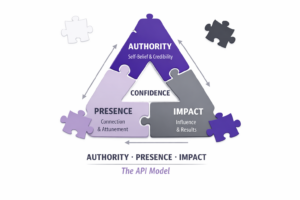
Authority: The internal sense of legitimacy and self-trust
Authority begins on the inside because it is less about role or hierarchy, and more about a leader’s relationship with themselves.
At its strongest, authority shows up as a grounded sense of legitimacy – I have a right to be here, to decide, to influence. It is not about being certain or getting it right every time; rather, it is about having the confidence to plan strategically and take action, even when things are unclear.
This is the internal experience we’ve been describing:
- Self-trust
- Clarity of judgement
- Willingness to take up space
- Acting without over-reliance on validation
- Outer authority
This is what others can see, verify, or attribute:
- Experience and track record
- Technical or professional expertise
- Qualifications and credentials
Leaders with developed authority tend to:
- Draw on an internal compass rather than relying solely on external approval
- Make decisions with sufficient – not complete – information
- Hold their position while remaining open to challenge
- Take responsibility without over-identifying with outcomes
When authority is less secure, it often surfaces in subtle ways:
- Over-reliance on consensus or reassurance
- Avoidance of difficult conversations
- Overcompensation through control or assertiveness
- A tendency to second-guess decisions after the fact
As Kegan & Lahey (2009) state, “Authority is not fixed – it is continually shaped by experience, reflection, and the narratives leaders hold about themselves.”
Presence: The relational field
Presence is not simply about confidence or charisma. It is about the quality of attention a leader brings into the moment, and how that attention is embodied and communicated. This often shows up in very practical, observable ways.
How you show up in meetings:
- Are you fully there or partially distracted?
- Do you create space, or fill it too quickly?
- Do people feel invited in, or held at a distance?
Your physical stance and posture:
- Grounded, open, and steady versus closed or restless
- How you position yourself in the room (or on screen)
- Whether your body signals availability or defensiveness
Body language and non-verbal cues:
- Eye contact, facial expression, and gestures
- Congruence between what you say and how you say it
- Awareness of the emotional tone you are setting
Use of voice and language:
- Pace, tone, and clarity of speech
- The balance between inquiry and advocacy
- Assertiveness – being clear and direct without overpowering
Emotional regulation:
- Staying composed under pressure
- Responding rather than reacting
- Allowing emotion without being driven by it
Relational awareness:
- Reading the room – what’s being said and unsaid
- Noticing shifts in energy or engagement
- Adapting your approach in real time
Presence is what allows authority to be felt rather than asserted. It is also what enables leaders to adapt – shifting between directive and facilitative modes as context demands.
In this sense, presence is the bridge between internal experience and external influence.
Impact: The effect a leader has on others, systems, and outcomes
Impact is where leadership becomes visible. It includes results, but extends beyond them to encompass the experience of being led and the patterns that emerge over time.
Leaders create impact by:
- The clarity they bring to strategic direction and purpose
- The level of ownership and agency others feel
- The quality of relationships and trust within teams
- The culture that is reinforced – intentionally or otherwise (Schein, 2010)
When impact is strong and aligned, there is coherence between intention, behaviour, and experience. When it is not, the gap often points back to authority or presence.
The Interplay: Why API matters for your leadership identity
What makes the API model particularly valuable is its emphasis on integration.
Consider:
- Authority without presence can feel rigid or disconnected
- Presence without authority can feel warm but ineffective
- Impact without either may be short-lived or unsustainable
Leadership identity is not a fixed trait but an evolving construct, shaped through experience, reflection, and the ongoing interplay between how we see ourselves and how others experience us.
Practical reflections for leaders
- Where do I locate my authority? How do I notice this shifting between internal conviction and others’ approval?
- How do I experience myself under pressure? What do others experience? What do I notice about whether I become more contracted or more open?
- What patterns of impact do I see emerging over time in how others respond to me and my leadership?
- When do I feel most grounded and legitimate as a leader, and what seems to enable that?
- How might others describe their experience of me in moments that matter most?
- In what situations do I find myself overplaying or underplaying my authority, and what is influencing that?
- What am I paying attention to in my conversations, and what might I be overlooking or choosing not to notice?
- How aligned is the impact I intend with the experience others actually have of me, and what might explain any gaps?
- What becomes possible when I bring greater awareness to my authority, presence, and impact in real time?
Final Thoughts
Kegan and Lahey (2009) state that, “Leadership identity is shaped not only by experience, but by reflection on that experience.” Leadership is not something we switch on in certain moments, it is something we embody – continuously, relationally and often imperfectly. The Authority, Presence, Impact model offers a simple yet effective structure to support that all important self- reflection.
References
- Hawkins, P., & Smith, N. (2003). Authority, Presence, Impact (API) model.
- Kegan, R., & Lahey, L. L. (2009). Immunity to Change. Harvard Business Press.
- Schein, E. H. (2010). Organizational Culture and Leadership (4th ed.). Jossey-Bass.